
Time Off Settings
Open Settings => Time Off Settings
(the page is available if your role has the Settings => Time Off permission)
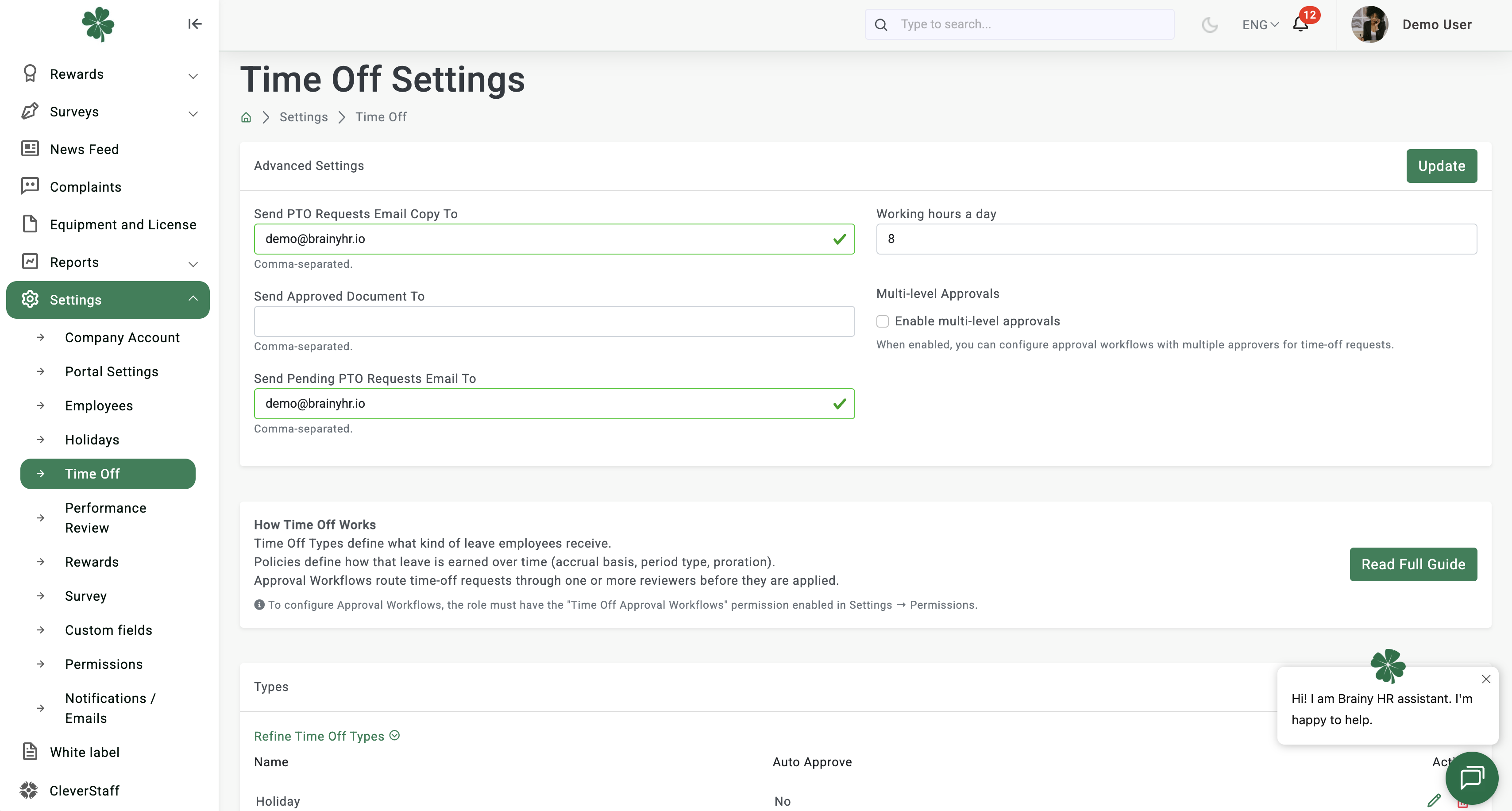
This guide shows how to set time off up. If you need the details behind the settings — how accrual periods are built, what happens to partial periods, how approval chains behave — see the Complete Guide to Time Off Management.
Advanced Settings
All Time-Off requests will be sent to the direct managers.
If you want to add additional persons to email notification, add it in Advanced Settings:
- Send PTO Requests Email Copy To — a copy of every new request.
- Send Approved Document To — a PDF document of every approved request.
- Send Pending PTO Requests Email To — a daily reminder with the requests that are still waiting for approval.
Each field accepts several addresses — separate them with a comma.
Working hours a day — how many working hours one day contains. Fill it in if you want to create policies and see balances in days, not only in hours.
Enable multi-level approvals — unlocks the Approval Workflows block (see the last step).
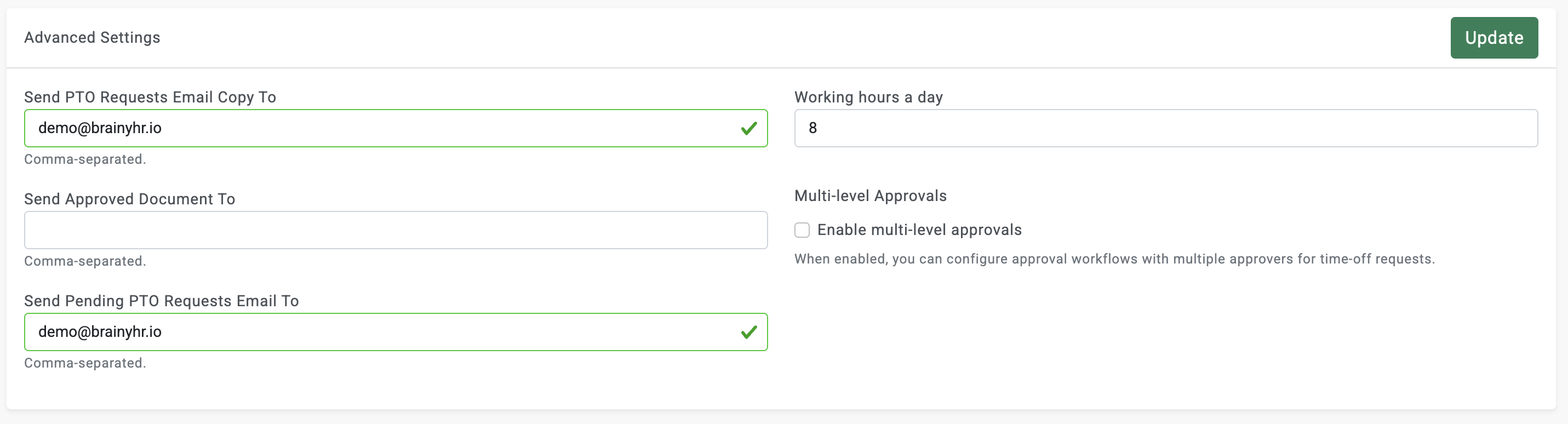
Press Update to save.
Types
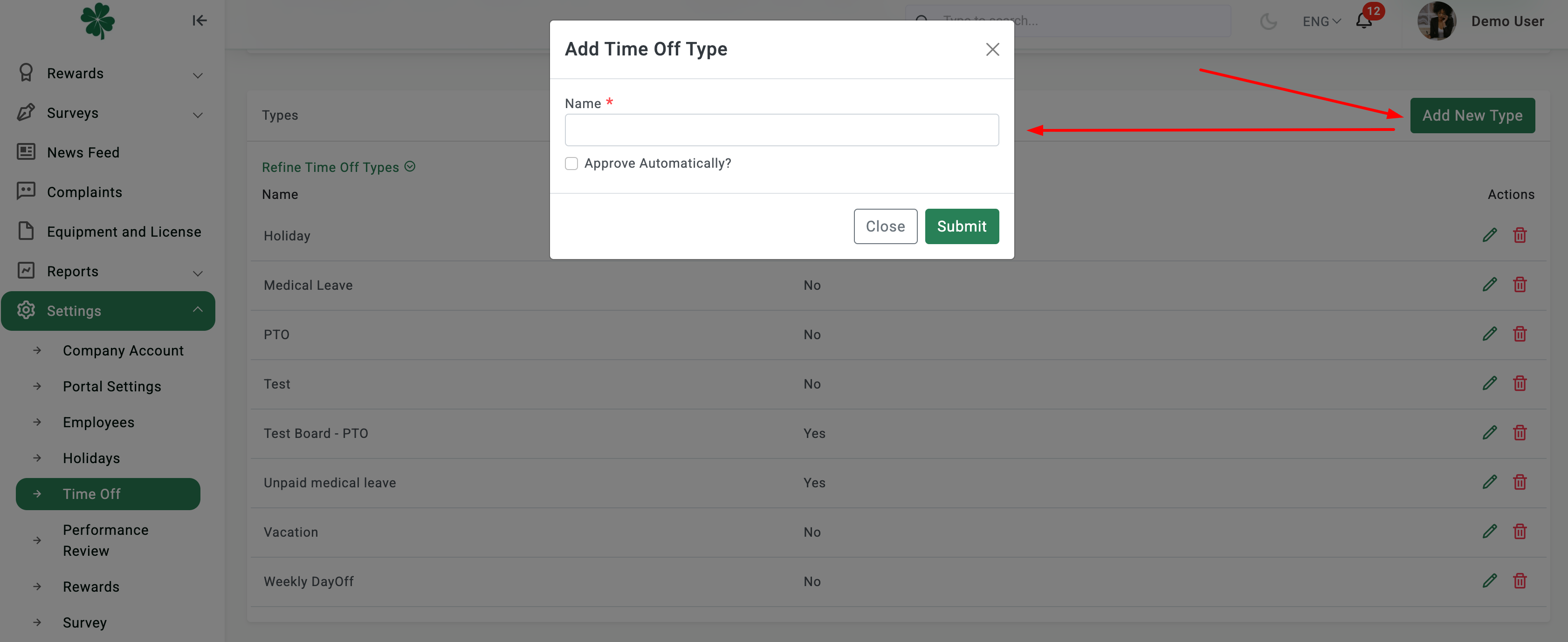
Create time-off types: medical leave, vacation, unpaid time-off, maternity leave etc.
If you want to auto approve some types (like vacation), mark Approve Automatically? in pop up:
It means that all request for this type will be approved automatically and employee don't need to wait for manager's approval.
If you uncheck it, manager needs to approve or reject request manually.
Employees see one balance per type — so a type is what they choose when they request time off.
Policies
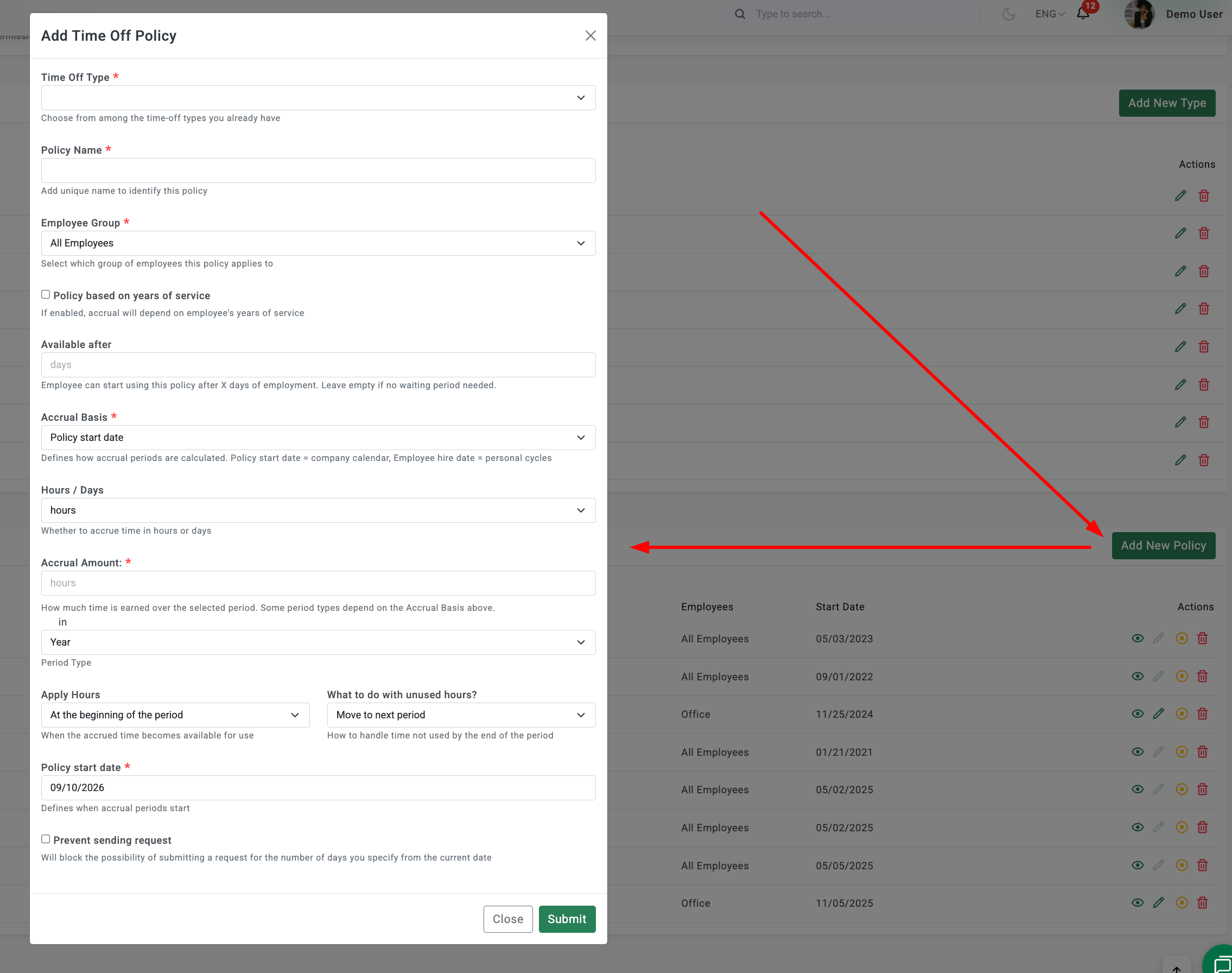
A policy is the rule that says how much time off is earned. Create new rule:
Choose a Time Off Type (from prev step).
Give the Policy Name.
Choose an Employee Group:
- all employees - will be applied to whole company.
- office - will be applied to some offices.
- department - will be applied to certain department only.
You can select several offices or departments at once. If the office or the department does not exist yet, create it right in the dialog — use the Add New Office / Add New Department link under the field.
Example:
You have an international team - one office in USA, one office in Ukraine.
USA Vacation - 2 weeks, UA vacation - 3 weeks.
So you need to create 2 policies - one for USA office (80 hours policy), second one for UA office (120 hours policy).
Then fill in the rest of the form:
- Policy based on years of service — turn it on if the amount depends on seniority, and set the Years of service from / to for this tier. Create one policy per tier, all attached to the same type.
- Available after — a waiting period in days of employment. Leave empty if there is none.
- Accrual Basis — Policy start date (all employees earn on the same company calendar) or Employee hire date (each employee has a personal cycle). The choice limits the available periods: the company calendar allows Year, Half-Year, Quarter, Month, 2 Weeks and Week, the personal cycle allows Year and Month.
- Hours / Days — the units of this policy. Shown only if Working hours a day is filled.
- Accrual Amount — how much time is earned in the selected period.
- Apply Hours at — at the beginning of the period (given in advance) or at the end of the period.
- What to do with unused hours — specify what to do with unused hours: lose or move to next period.
- Policy start date — the date the policy starts working from.
Prevent sending a request: you can set minimum days before sending a request.
For example vacation request can't be sent right before vacation.
Example:
minimum 7 days before sending a request:
7 days are blocked in request so user can't request it for tomorrow.
NOTE: if an employee joins in the middle of a period, the first period is prorated automatically — no manual adjustment is needed.
Managing the policies you created
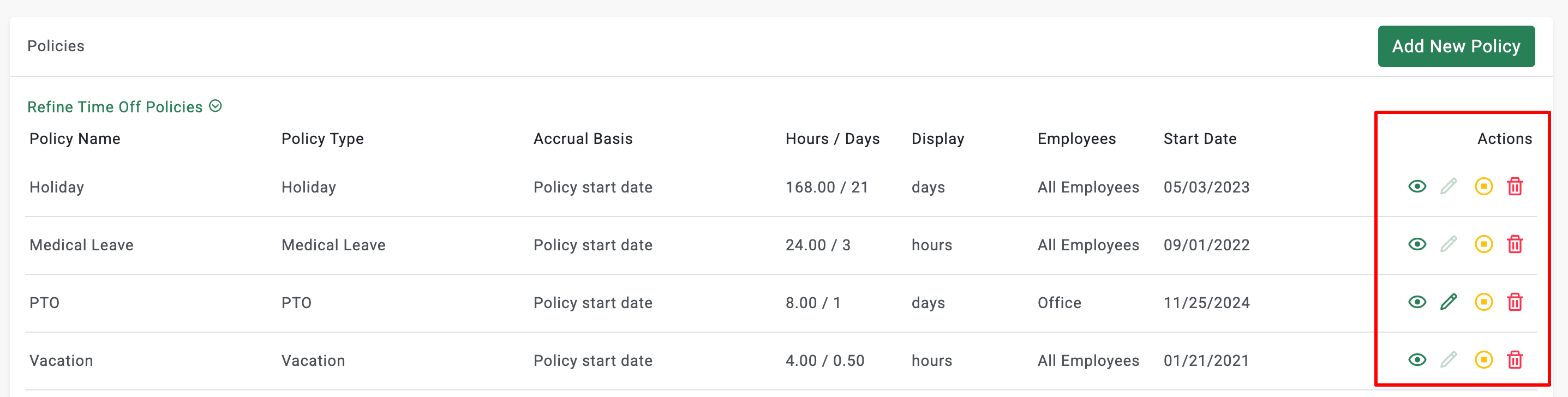
Use Refine Time Off Policies to filter the list by name, type or employee group. Every row has four actions:
- View — all settings of the policy, read-only.
- Edit — available only while nobody has used hours accrued under this policy.
- Deactivate — stops future accruals; everything already earned stays in the balance. It cannot be undone, so if the rules change, deactivate the old policy and create a new one for the same type.
- Remove — deletes the policy.
More about editing and deactivating — in the Complete Guide to Time Off Management.
Approval Workflows
By default a request is approved by one person — the reviewer who has the permission to approve time off for that employee.
If a request has to pass several people (for example the direct manager and then HR), enable Multi-level Approvals in Advanced Settings, press Update, and the Approval Workflows block will be unlocked.
Click Add New Approval Workflow and fill in:
- Workflow Name and Description.
- Apply to Policies — one or more policies. One policy can belong to one workflow only.
- Approval Levels — the approvers in order: level 1 approves first, the last level is the final approver. For every level choose Specific user or Direct manager of requester (one such level per workflow). Use ↑ ↓ to reorder.
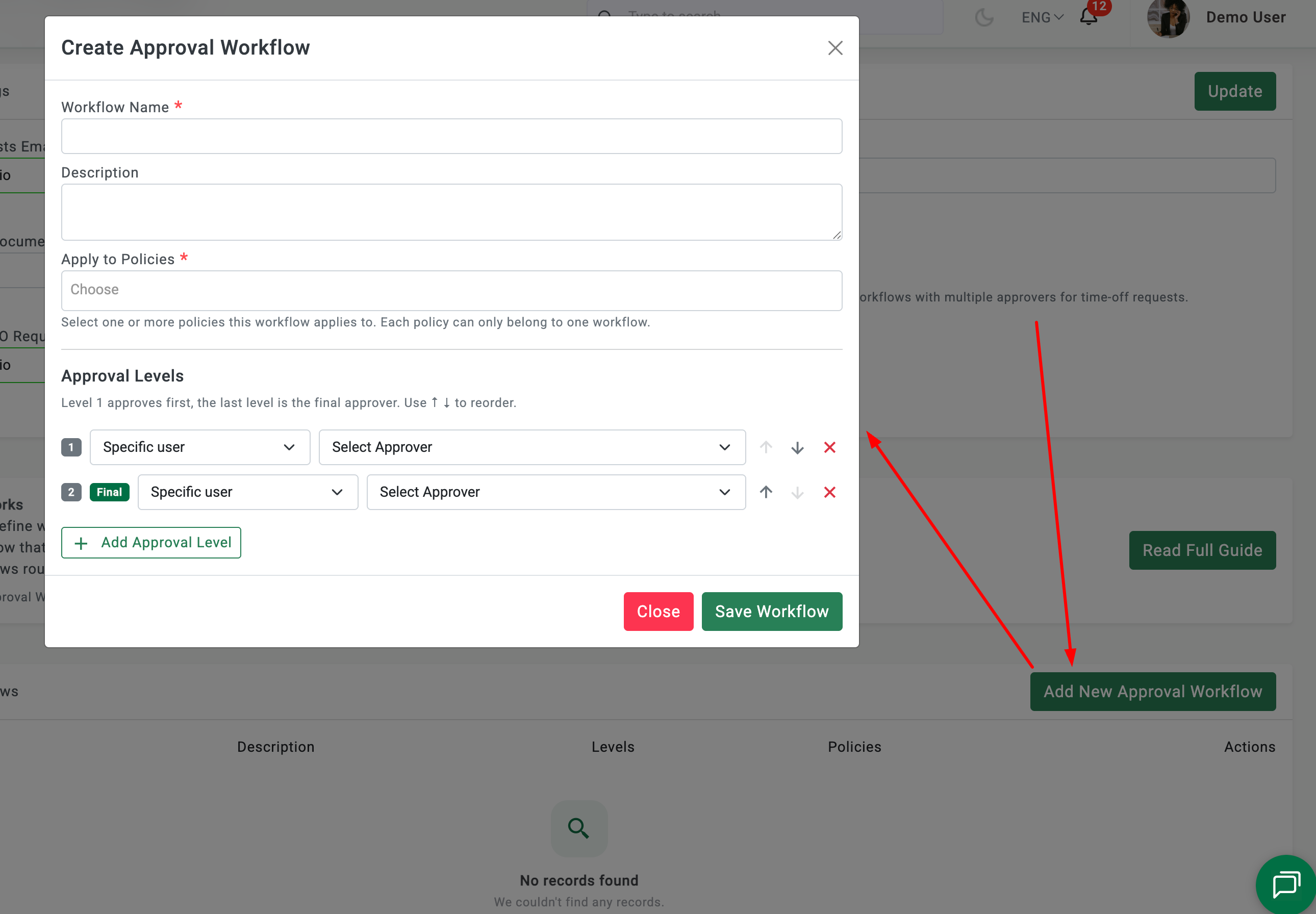
Levels are passed one by one, and a rejection at any level rejects the whole request.
NOTE: every approver must have the Approve Time Off permission, otherwise the request will wait for them and will be marked as stuck.
NOTE: the Approval Workflows block is visible only for roles with the Time Off Approval Workflows permission (Settings => Permissions).
Skip logic, stuck requests, changing an approver mid-flight and other cases are described in the Complete Guide to Time Off Management.